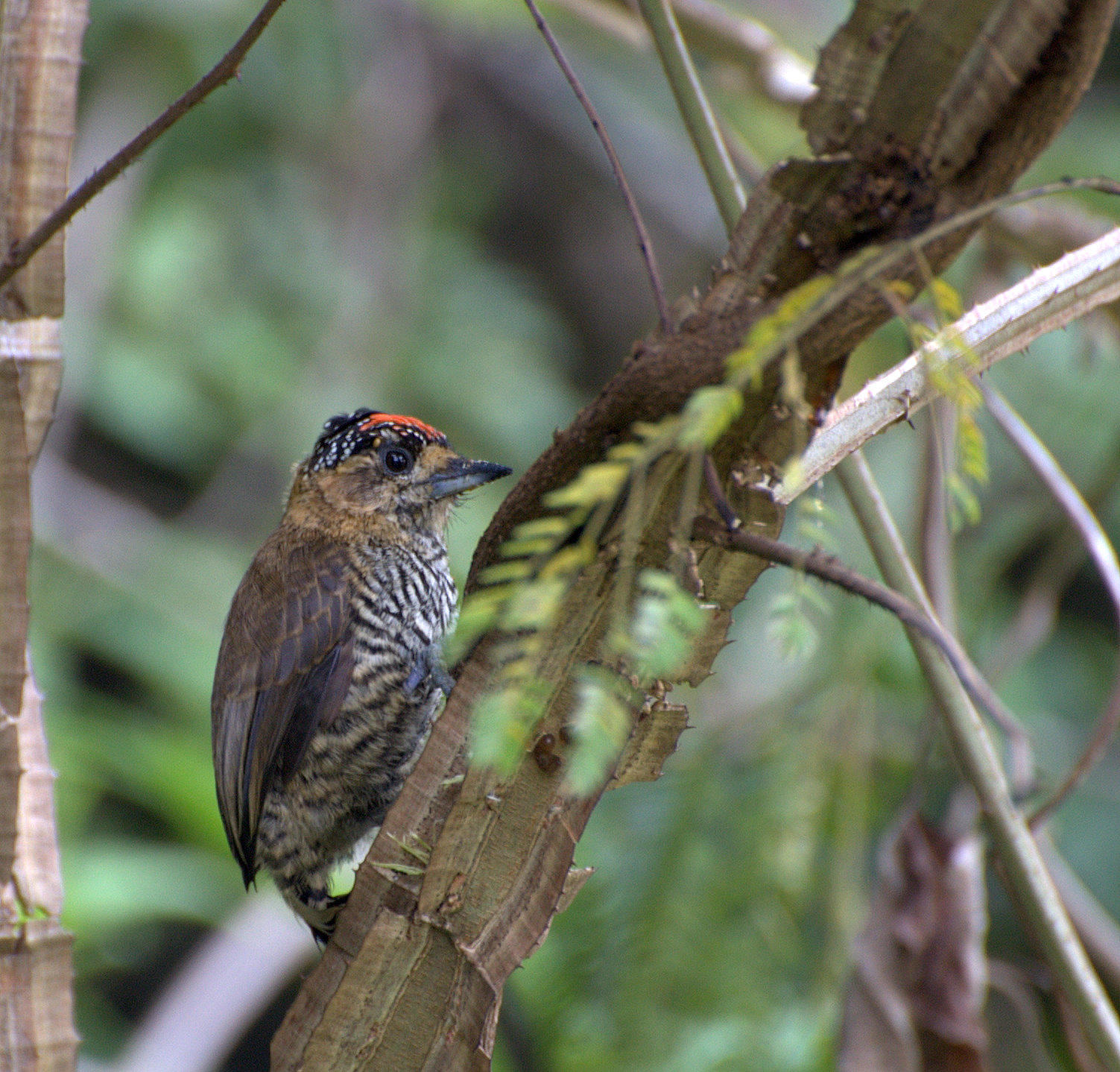
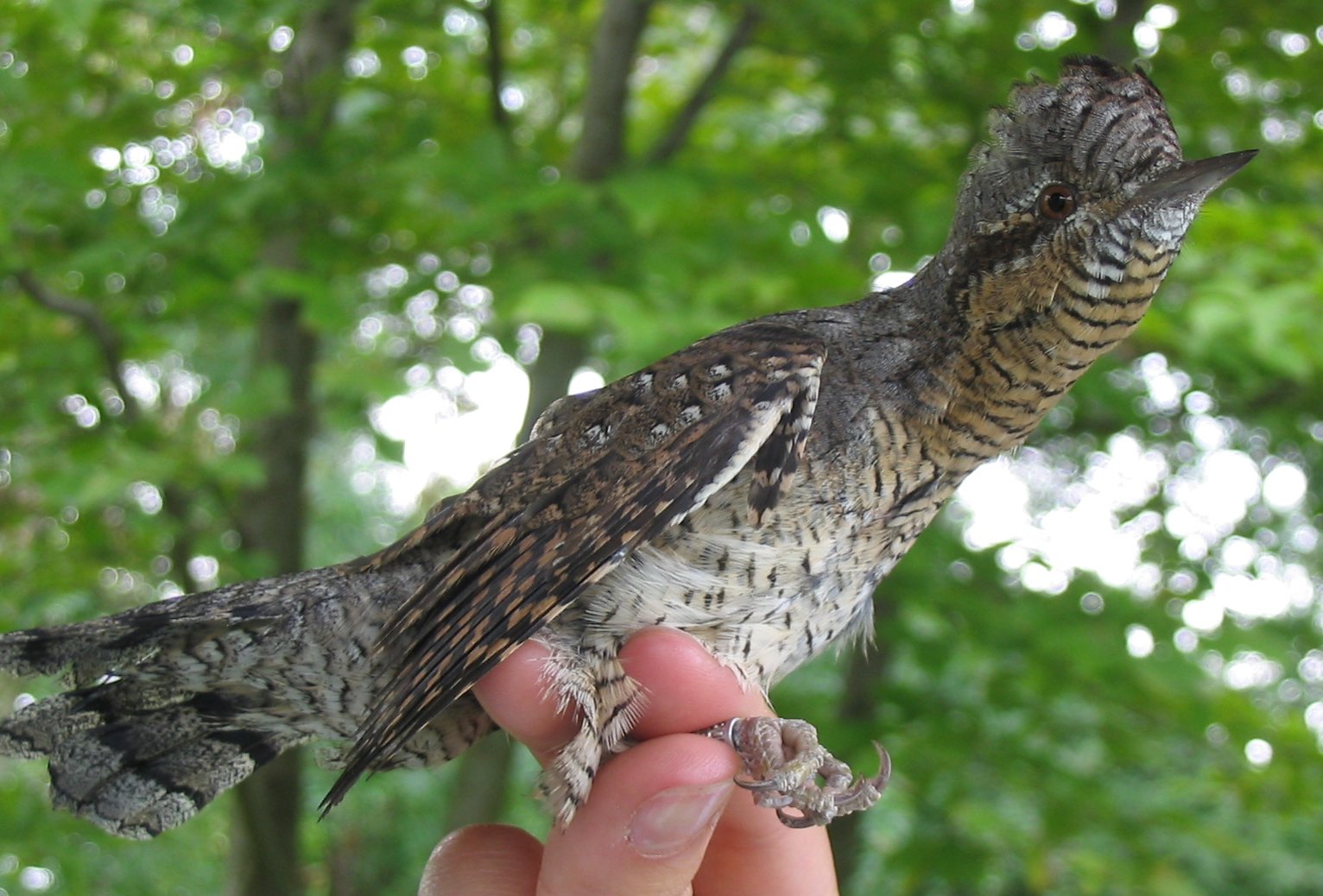
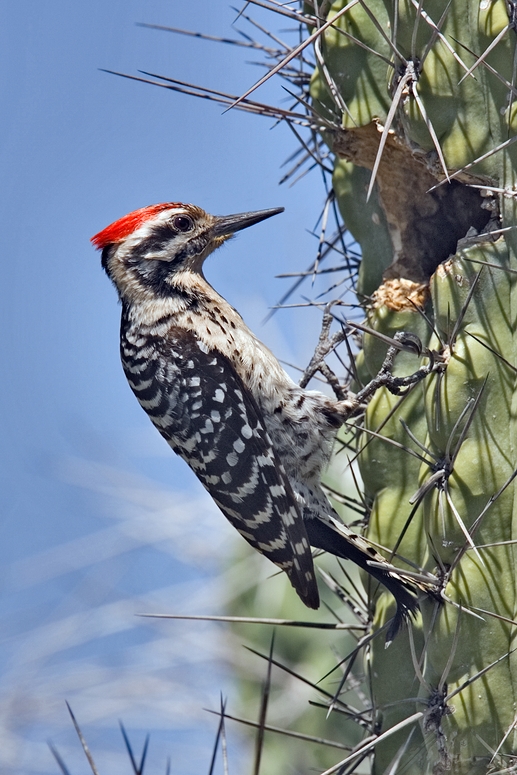
The woodpeckers, piculets and wrynecks are a family, Picidae, of near-passerine birds. Members of this family are found worldwide, except for Australia and New Zealand, Madagascar, and the extreme polar regions. Most species live in forests or woodland habitats, although a few species are known to live in treeless areas such as rocky hillsides and deserts.
The Picidae are just one of the eight living families in the order Piciformes. Members of the order Piciformes, such as the jacamars, puffbirds, barbets, toucans and honeyguides, have traditionally been thought to be very closely related to the woodpeckers, piculets and wrynecks. More recently, DNA sequence analyses have confirmed this view.[1]
There are about 200 species and about 30 genera in this family. Many species are threatened or endangered due to loss of habitat or habitat fragmentation. Two species of woodpeckers, the Ivory-billed Woodpecker and the Imperial Woodpecker, have been considered extinct for about 30 years (there has been some controversy recently whether these species still exist).
Description
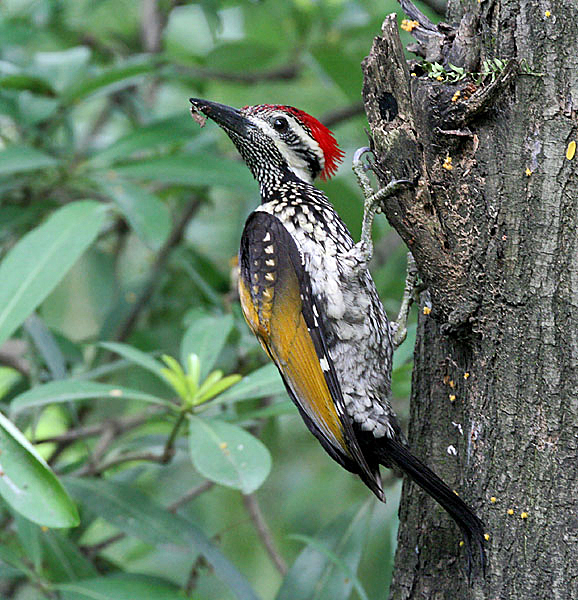 The smallest woodpecker is the Bar-breasted Piculet, at 7 g and 8 cm (3 1/4 inches). The largest woodpecker was the Imperial Woodpecker, at an average of 58 cm (23 inches) and probably over 600 g (1.3 lb). The Ivory-billed Woodpecker is (or was) slightly smaller at 50 cm (20 inches) and a weight of 500 g (1.1 lb). If both the Ivory-billed and Imperial Woodpeckers are indeed extinct, the largest extant woodpecker is the Great Slaty Woodpecker of Southeast Asia, at about 50 cm (20 inches) and 450 g (1 lb). A number of species exhibit sexual dimorphism in size, bill length and weight. In the piculets it is often the females that are larger, amongst the woodpeckers that show sexual dimorphism it is usually the males that are larger.
 Most species possess predominantly white, black and brown, green and red plumage, although many piculets show a certain amount of grey and olive green. In woodpeckers, many species exhibit patches of red and yellow on their heads and bellies, and these bright areas are important in signalling. The dark areas of plumage are often iridescent. Although the sexes of Picidae species tend to look alike, many woodpecker species have more prominent red or yellow head markings in males than in females.
Members of the family Picidae have strong bills for drilling and drumming on trees and long sticky tongues for extracting food.[2] Woodpecker bills are typically longer, sharper and stronger than the bills of piculets and wrynecks; however their morphology is very similar. The bill's chisel-like tip is kept sharp by the pecking action in birds that regularly use it on wood. Species of woodpecker and flicker that use their bills in soil or for probing as opposed to regular hammering tend to have longer and more decurved bills. Due to their smaller bill size, many piculets and wrynecks will forage in decaying wood more often than woodpeckers. The long sticky tongues, which possess bristles, aid these birds in grabbing and extracting insects deep within a hole of a tree. It had been reported that the tongue was used to spear grubs, but more detailed studies published in 2004 have shown that the tongue instead wraps around the prey before being pulled out.[3]Many of the foraging, breeding and signaling behaviors of woodpeckers involve drumming and hammering using the bill.[4] To prevent brain damage from the rapid and repeated decelerations, woodpeckers have evolved a number of adaptations to protect the brain. These include small brain size, the orientation of the brain within the skull (which maximises the area of contact between the brain and the skull) and the short duration of contact. The millisecond before contact with wood a thickened nictitans membrane closes, protecting the eye from flying debris.[5] The nostrils are also protected; they are often slit-like and have special feathers to cover them.
Woodpeckers, piculets and wrynecks all possess zygodactyl feet. Zygodactyl feet consist of four toes, the first and the fourth facing frontward and the second and third facing back. This foot arrangement is good for grasping the limbs and trunks of trees. Members of this family can walk vertically up a tree trunk, which is beneficial for activities such as foraging for food or nest excavation. In addition to the strong claws and feet woodpeckers have short strong legs, this is typical of birds that regularly forage on trunks. The tails of all woodpeckers except the piculets and wrynecks are stiffened, and when the bird perches on vertical surfaces, the tail and feet work together to support it. [2]
Distribution, habitat and movements
 The woodpeckers have a mostly cosmopolitan distribution, although they are absent from Australasia, Madagascar and Antarctica. They are also absent from the world's oceanic islands, although many insular species are found on continental islands. The true woodpeckers, subfamily Picinae, are distributed across the entire range of the woodpeckers. The Picumninae piculets have a pantropical distribution, with species in Southeast Asia, Africa and the Neotropics, with South America holding the majority of piculet species. The second piculet subfamily, Nesoctitinae, has a single species, the Antillean Piculet, which is restricted to the Caribbean island of Hispaniola. The wrynecks (Jynginae) have an exclusively Old World distribution, with the two species occurring in Europe, Asia and Africa.
Overall the woodpeckers are arboreal birds of wooded habitats. They reach their greatest diversity in tropical rainforests, but occur in almost all suitable habitats including woodlands, savannahs, scrublands, bamboo forests. Even grasslands and deserts have been colonised by various species. These habitats are more easily occupied where a small number of trees exist, or, in the case of desert species like the Gila Woodpecker, tall cacti are available for nesting in.[6] A number of species are adapted to spending a portion of their time feeding on the ground, and a very small minority of species have abandoned trees entirely and nest in holes in the ground. The Ground Woodpecker is one such species, inhabiting the rocky and grassy hills of South Africa.
Picidae species can either be sedentary or migratory. Many species are known to stay in the same area year-round while others travel great distances from their breeding grounds to their wintering grounds. For example, the Eurasian Wryneck breeds in Europe and west Asia and migrates to the Sahel in Africa in the winter.[7]
Results from the monitoring programs of the Swiss Ornithological Institute show that the breeding populations of several forest species for which deadwood is an important habitat element (black woodpecker, great spotted woodpecker, middle spotted woodpecker, lesser spotted woodpecker, green woodpecker, three-toed woodpecker as well as crested tit, willow tit and Eurasian tree creeper) have increased in the period 1990 to 2008, although not to the same extent in all species. At the same time the white-backed woodpecker extended its range in eastern Switzerland. The Swiss National Forest Inventory shows an increase in the amount of deadwood in forests for the same period. For all the mentioned species, with the exception of green and middle spotted woodpecker, the growing availability of deadwood is likely to be the most important factor explaining this population increase.
Behavior
The woodpeckers range from highly antisocial solitary species that are aggressive to other members of their species, to species that live in groups. Group-living species tend to be communal group breeders. In addition to these species, a number of species may join mixed-species feeding flocks with other insectivorous birds, although they tend to stay at the edges of these groups. Joining these flocks allows woodpeckers to decrease anti-predator vigilance and increase their feeding rate.[8] Woodpeckers are diurnal, roosting at night inside holes. In most species the roost will become the nest during the breeding season.
Diet and feeding
 The diet of woodpeckers consists mainly of insects and their grubs taken from living and dead trees, and other arthropods, along with fruit from live trees, nuts and sap both from live trees. Their role ecologically is thereby keeping trees healthy by keeping them from suffering mass infestations. The family is noted for its ability to acquire wood-boring grubs using their bills for hammering, but overall the family is characterized by its dietary flexibility, with many species being both highly omnivorous and opportunistic. The insect prey most commonly taken are insects found inside tree trunks, whether they are alive or rotten wood and in crevices in bark on trees. These include beetles and their grubs, ants, termites, spiders, and caterpillars. These may be obtained either by gleaning or more famously by excavating wood. Having hammered a hole into the wood the prey is excavated by a long barbed tongue. The ability to excavate allows woodpeckers to obtain tree sap, an important source of food for some species. Most famously the sapsuckers, (genus Sphyrapicus ) feed in this fashion, but the technique is not restricted to these and others such as the Acorn Woodpecker and White-headed Woodpecker also feed in this way. It was once thought that the technique was restricted to the New World, but Old World species such as the Arabian Woodpecker and Great Spotted Woodpecker also feed in this way.[2]
Breeding
 All members of the family Picidae nest in cavities. Almost every species nests in tree cavities, although in deserts some species nest inside holes in cactus and a few species nest in holes dug into the earth. Woodpeckers and piculets will excavate their own nests, but wrynecks will not. The excavated nest is usually only lined from the wood chips produced as the hole was made. Many species of woodpeckers excavate one hole per breeding season, sometimes after multiple attempts. It takes around a month to finish the job. Abandoned holes are used by other birds and mammals that are secondary cavity nesters.[9] Because nesting holes are in great demand by other cavity nesters, woodpeckers face competition for the nesting sites they excavate from the moment the hole becomes usable. This may come from other species of woodpecker, or other cavity nesting birds like swallows and starlings. Woodpeckers may aggressively harass potential competitors, and also use other strategies to reduce the chance of being usurped from their nesting site; for example the Red-crowned Woodpecker digs its nest in the underside of a small branch, which reduces the chance that a larger species will take it over and expand it.[10]
Members of Picidae are typically monogamous, with a few species breeding cooperatively and some polygamy reported in a few species.[11] Polyandry, where a female raises two broods with two separate males, has also been reported in the West Indian Woodpecker.[12] A pair will work together to help build the nest, incubate the eggs and raise their altricial young. However, in most species the male does most of the nest excavation and takes the night shift while incubating the eggs. A nest will usually consist of 2-5 round white eggs. Since these birds are cavity nesters, their eggs do not need to be camouflaged and the white color helps the parents to see them in dim light. The eggs are incubated for about 11–14 days before the chicks are born. It takes about 18–30 days before the young are ready to leave the nest.
Systematics and evolution
The phylogeny has been updated according to new knowledge about convergence patterns and evolutionary history.[13] Most notably, the relationship of the picine genera has been largely clarified, and it was determined that the Antillean Piculet is a surviving offshoot of proto-woodpeckers.
The evolutionary history of this group is not well documented, but the known fossils allow some preliminary conclusions: the earliest known modern picids were piculet-like forms of the Late Oligocene, about 25 million years ago (mya). By that time, however, the group was already present in the Americas and Europe, and it is hypothesized that they actually evolved much earlier, maybe as early as the Early Eocene (50 mya). The modern subfamilies appear to be rather young by comparison; until the mid-Miocene (10-15 mya), all picids seem to have been small or mid-sized birds similar to a mixture between a piculet and a wryneck. On the other hand, there exists a feather enclosed in fossil amber from the Dominican Republic, dated to about 25 mya, which seems to indicate that the Nesoctitinae were already a distinct lineage by then.[14]
Prehistoric representatives of the extant Picidae genera are treated in the genus articles. An enigmatic form based on a coracoid found in Pliocene deposits of New Providence, Bahamas, has been described as Bathoceleus hyphalus and probably also is a woodpecker.[15]
 The White Woodpecker, Melanerpes candidus, is a species of woodpecker (Family Picidae) found in South America. This woodpecker is a native of the grasslands of Brazil, Bolivia, Paraguay, Uruguay and Argentina.