Saturday, February 5, 2011

White-fronted Woodpecker
The White-fronted Woodpecker (Melanerpes cactorum) is a species of bird in the Picidae family.
It is found in Argentina, Bolivia, Brazil, Paraguay, Peru, and Uruguay.
File:Melanerpes cactorum -Argentina-8.jpgIts natural habitats are subtropical or tropical dry forests, subtropical or tropical dry shrubland, and subtropical or tropical high-altitude shrubland
Yellow-fronted Woodpecker
The Yellow-fronted Woodpecker (Melanerpes flavifrons) is a species of bird in the Picidae family. It is found in Argentina, Brazil, and Paraguay. Its natural habitats are subtropical or tropical moist lowland forests and heavily degraded former forestFile:Melanerpes flavifrons.jpg
Black-cheeked Woodpecker
File:Black-cheeked Woodpecker.jpgThe Black-cheeked Woodpecker, Melanerpes pucherani, is a resident breeding bird from southeastern Mexico south to western Ecuador.
This woodpecker occurs in the higher levels of wet forests, semi-open woodland and old second growth. It nests in an unlined hole 6–30 m high in a dead tree. The clutch is two to four glossy white eggs, incubated by both sexes. The binomial commemorates the French zoologist Jacques Pucheran.
The Black-cheeked Woodpecker feeds on insects, but will take substantial quantities of fruit and nectar.
This common and conspicuous species gives a rattling krrrrrl call and both sexes drum on territory.


Description
File:Melanerpes pucherani -Costa Rica -female-8.jpgThe adult is 18.5 cm long and weighs 63 g. It has black upperparts with white barring on the back, white spotting on the wings and a white rump. The tail is black with some white barring, and the underparts are pale buff-olive with a red central belly. There is a black patch through the eys and on the cheeks, a yellow forehead, and a red nape. The crown is red in the male and black in the female. Young birds are duller, have less white above and less red on the belly.

Acorn Woodpecker
The Acorn woodpecker (Melanerpes formicivorus) is a medium-sized woodpecker, 21 cm long with an average weight of 85 g.
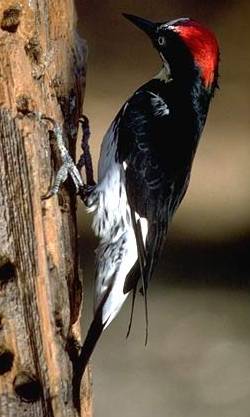
The adult has a black head, back, wings and tail, white forehead, throat, belly and rump. The eyes are white. The adult male has a red cap starting at the forehead, whereas females have a black area between the forehead and the cap. The white neck, throat and forehead patches are distinctive identifiers.
Breeding communities
The breeding habitat is forested areas with oaks in the hills of coastal California and the southwestern United States south to Colombia. This species may occur at low elevations in the north of its range, but rarely below 1000m in Central America, and it breeds up to the timberline. The breeding pair excavate a nest in a large cavity in a dead tree or a dead part of a tree. A group of adults may participate in nesting activities: Field studies have shown that breeding groups range from monogamous pairs to breeding collectives of seven males and three females, plus up to 10 nonbreeding helpers. Young have been found with multiple paternity.[1]
Food and homes
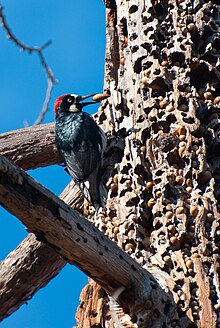
Acorn woodpeckers, as their name implies, depend heavily on acorns for food. In some parts of their range (e.g., California), the woodpeckers create granaries or "acorn trees" by drilling holes in dead trees, dead branches, telephone poles and wooden buildings. The woodpeckers then collect acorns and find a hole that is just the right size for the acorn. As acorns dry out, they are moved to smaller holes and granary maintenance requires a significant amount of the bird's time. They also feed on insects, sap, and fruit.
Defense and storing
The acorns are visible, and the group defends the tree against potential cache robbers like Steller's Jays and Western Scrub Jays. Acorns are such an important resource to the California populations that Acorn Woodpeckers may nest in the fall to take advantage of the fall acorn crop, a rare behavior in birds [2]. Acorn Woodpeckers can also be seen sallying from tree limbs to catch insects, eating fruit and seeds, and drilling holes to drink sap. The Acorn Woodpecker will use any human-made structures to store acorns, drilling holes into fence posts, utility poles, buildings, and even automobile radiators. Occasionally the woodpecker will put acorns into places where it cannot get them out. Woodpeckers put 220 kg (485 lb) of acorns into a wooden water tank in Arizona. In parts of its range the Acorn Woodpecker does not construct a granary tree, but instead stores acorns in natural holes and cracks in bark. If the stores are eaten, the woodpecker will move to another area, even going from Arizona to Mexico to spend the winter.
Breeding behavior
In California, Acorn Woodpeckers breed from April – June. An Acorn Woodpecker group may consist of 1-7 male breeders that compete to mate with 1-3 females. The nest is excavated in a large tree, which may also be a granary tree. Tree cavities are created in both dead and living trees and snags and nest holes are reused for many years. Females typically lay 5 eggs that are incubated for 11–14 days. Male and females incubate and tend to their young. Non-breeding helpers (young from previous years) often help with incubation and other parental duties. The young leave the nest and take their first flight at approximately 30–32 days after hatching and return to the nest to be fed for several weeks.
Breeding female
In groups with more than one breeding female, the females put their eggs into a single nest cavity. A female usually destroys any eggs in the nest before she starts to lay, and more than one third of all eggs laid in joint nests are destroyed. Once all the females start to lay, they stop removing eggs.
This bird is a permanent resident throughout its range. They may relocate to another area if acorns are not readily available. It is sedentary and very sociable.
Threats and degradation
Acorn Woodpeckers like many other species are threatened by habitat loss and degradation. Competition for nest cavities by non-native species is an ongoing threat in urbanized areas. Conservation of this species is dependent on the maintenance of functional ecosystems that provide the full range of resources upon which the species depends. These include mature forests with oaks capable of producing large mast crops and places for the woodpeckers to nest, roost, and store mast. Residents are encouraged to preserve mature oak and pine-oak stands of trees and to provide dead limbs and snags for nesting, roosting and granary sites to help preserve the Acorn Woodpeckers population.
Popular culture
Walter Lantz is believed to have patterned the call of his cartoon character Woody Woodpecker on that of the acorn woodpecker, while patterning his appearance on that of the Pileated Woodpecker which has a prominent crest.[3]

Red-headed Woodpecker
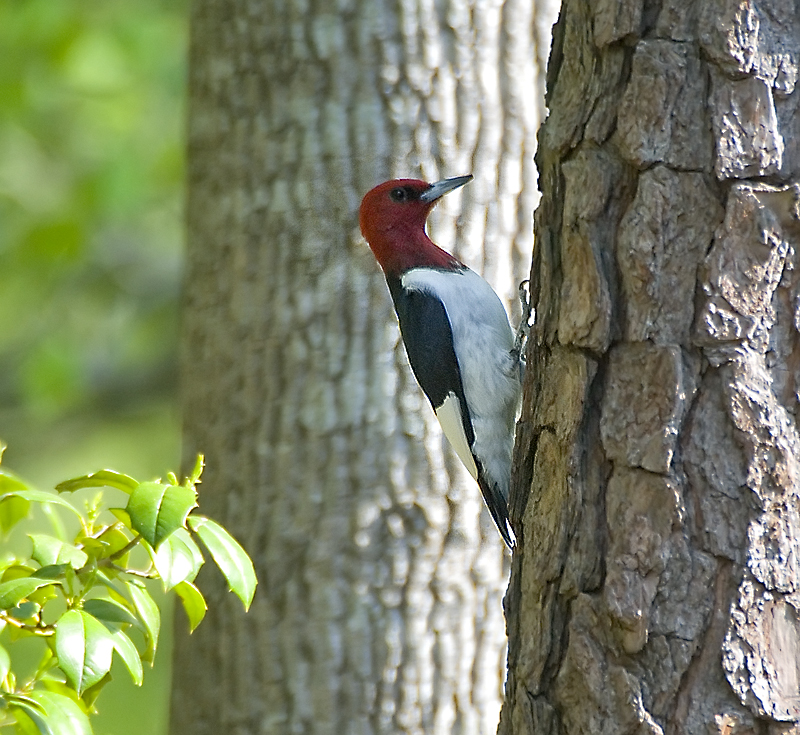
File:Melanerpes erythrocephalus -tree trunk-USA.jpgThe Red-headed Woodpecker, Melanerpes erythrocephalus, is a small or medium-sized woodpecker from temperate North America. Their breeding habitat is open country across southern Canada and the eastern-central United States.
Taxonomy
The Red-headed Woodpecker was one of the many species originally described by Linnaeus in his 18th-century work Systema Naturae.[1] The specific epithet is derived from the Ancient Greek words erythros 'red' and kephalos 'head'.[2]
There are three subspecies recognized:
  • M. e. brodkorbi
  • M. e. caurinus
  • M. e. erythrocephalus
Description
File:Red Headed Woodpecker5.JPGAdults are strikingly tri-colored, with a black back and tail and a red head and neck. Their underparts are mainly white. The wings are black with white secondary remiges. Adult males and females are identical in plumage.[3] Juveniles are similarly shaded, but are mottled with brown.[3] Non-birders may often mistakenly identify Red-bellied Woodpeckers as Red-headeds, whose range overlaps somewhat with that of the Red-headed woodpecker. While red-bellied woodpeckers have some bright red on the backs of their necks and heads, red-headed woodpeckers have a much deeper red that covers their entire heads and necks, as well as a different overall plumage pattern.
Puerto Rican Woodpecker
The Puerto Rican Woodpecker (Melanerpes portoricensis) is the only woodpecker endemic to the archipelago of Puerto Rico and is one of the five species of the Melanerpes genus that occur in the Antilles. Furthermore, it is the only resident species of the Picidae family in Puerto Rico. The species is common in the main island of Puerto Rico and rare in the island of Vieques.
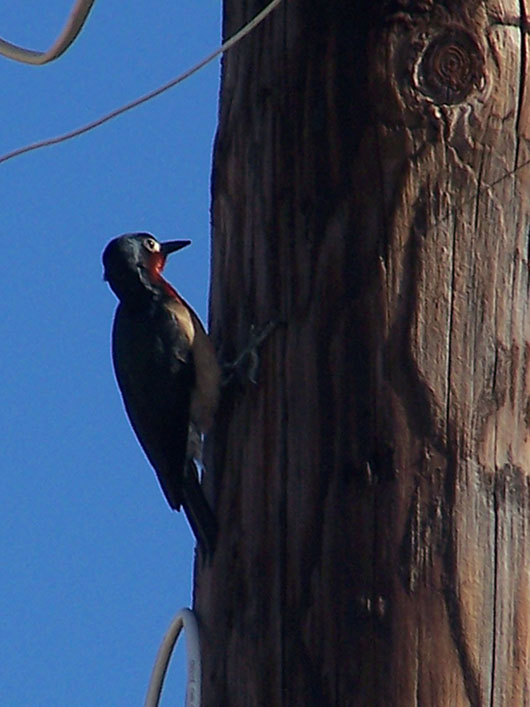
File:Puerto Rican Woodpecker.jpgDescription
The Puerto Rican Woodpecker has a black body and a bright red throat and breast. It has a white patch that runs across the head from eye to eye. Its flanks and lower body have a light tangerine coloration. As with the majority of birds sexual dimorphism is present in this species. The males' throat and breast are more brightly colored than the females' with females tending to be all-around duller in coloration. There is also a substantial (~18%) difference in bill length between sexes.[2] Also males are slightly bigger than females. Its average weight is 56.0 grams.[3] Its body length varies between 23 and 27 centimetres.
The Puerto Rican Woodpecker is a common and widely distributed species in Puerto Rico, mainly occurring in forests, coffee plantations, mangroves, palm tree groves, parks and gardens. Besides occurring in Puerto Rico it once inhabited the island of St. Croix. This stems from the fact that during the Pleistocene epoch Puerto Rico, Vieques, Culebra, St. Croix and the other Virgin Islands constituted a single landmass. It is believed that at this time the species extended its range to St.Croix and Vieques.[4]
The Puerto Rican Woodpecker is said to resemble the behavior and structure of the North American Red-headed Woodpecker (Melanerpes erythrocephalus).[4] Like the majority of woodpeckers this species uses its bill to drill holes in trunks in search of prey. The principal component of its diet are insects such as ants, beetle larvae and others. Fruits are also important, composing one-quarter of its diet. Rarely it may eat scorpions, geckos and coquís. Females lay from 1 to 6 white eggs in cavities carved by males. The nests of M. portoricensis are used by other Puerto Rican endemic birds such as the Puerto Rican Flycatcher (Myiarchus antillarum) and the Yellow-shouldered Blackbird (Agelaius xanthomus).[5]
Lewis's Woodpecker
The Lewis's Woodpecker, Melanerpes lewis, is a large North American species of woodpecker which was named for Meriwether Lewis, one of the explorers who surveyed the areas bought by the United States of America during the Louisiana Purchase.
Contents [hide]
1 Description
2 Range and habitat
3 Feeding
4 Breeding
Description
File:Lewis's Woodpecker.jpgOne of the largest species of American woodpeckers, Lewis's Woodpecker can be as large as 10 to 11 inches in length. It is mainly reddish-breasted, blackish-green in color with a black rump. It has a gray collar and upper breast, with a pinkish belly, and a red face. The wings are much broader than those of other woodpeckers, and it flies at a much more sluggish pace with slow, but even flaps similar to those of a crow.
Range and habitat
Lewis's Woodpecker is locally common, dwelling mostly in open pine woodlands, and other areas with scattered trees. Unlike other American woodpeckers, it enjoys sitting in the open as opposed to sitting in heavy tree cover. It ranges mostly in the western to central United States, but can winter as far south as the US border with Mexico and summer as far north as Canada.
Feeding
File:Melanerpes lewis -California -USA-8.jpgLewis's Woodpecker engages in some rather un-woodpecker-like behavior in its gregarious feeding habits. Although it does forage for insects by boring into trees with its chisel-like bill, the bird also catches insects in the air during flight, (typical insect hawking), a habit that only a few other woodpeckers, such as the Acorn woodpecker, the Red-headed Woodpecker and the Northern flicker, engage in. Lewis's Woodpecker also feeds on berries and nuts, and will even shell and store nuts in cracks and holes in wood to store until winter.
Breeding
File:Lewis's woodpecker (Melanerpes lewis ) with bug in it's bill.jpgLewis's Woodpecker nests in a cavity excavated from a dead tree branch. The nest is constructed mainly by the male. The female will lay between 5 and 9 eggs, which are plain white in coloration. Incubation is done by both sexes – the female sitting during the day and the male sitting at night – and lasts approximately 12 days, after which the young will hatch. The young leave the nest 4 to 5 weeks after hatching.